A history of interpretation begins with an author’s actual page. In Phaleg I.10, Samuel Bochart connects the geography of Abraham’s ancestors with his account of Babel, covenant and the preservation of language. His argument gives us several steps to inspect.
Keep the page in view.
Geographiae sacrae pars prior was published at Caen in 1646, as recorded in Oxford’s catalogue. The precise edition represented by these supplied images is not yet confirmed. Work-level publication date and screenshot edition are distinct facts. S07
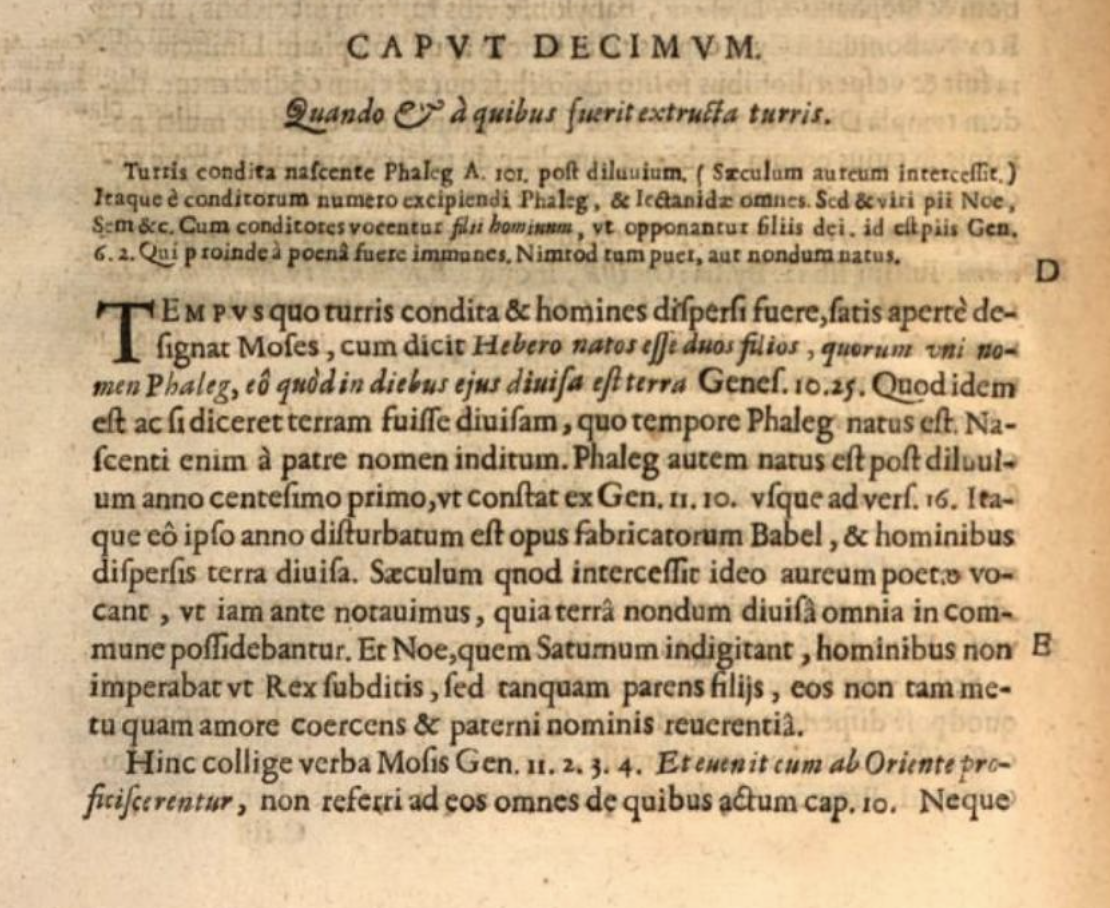
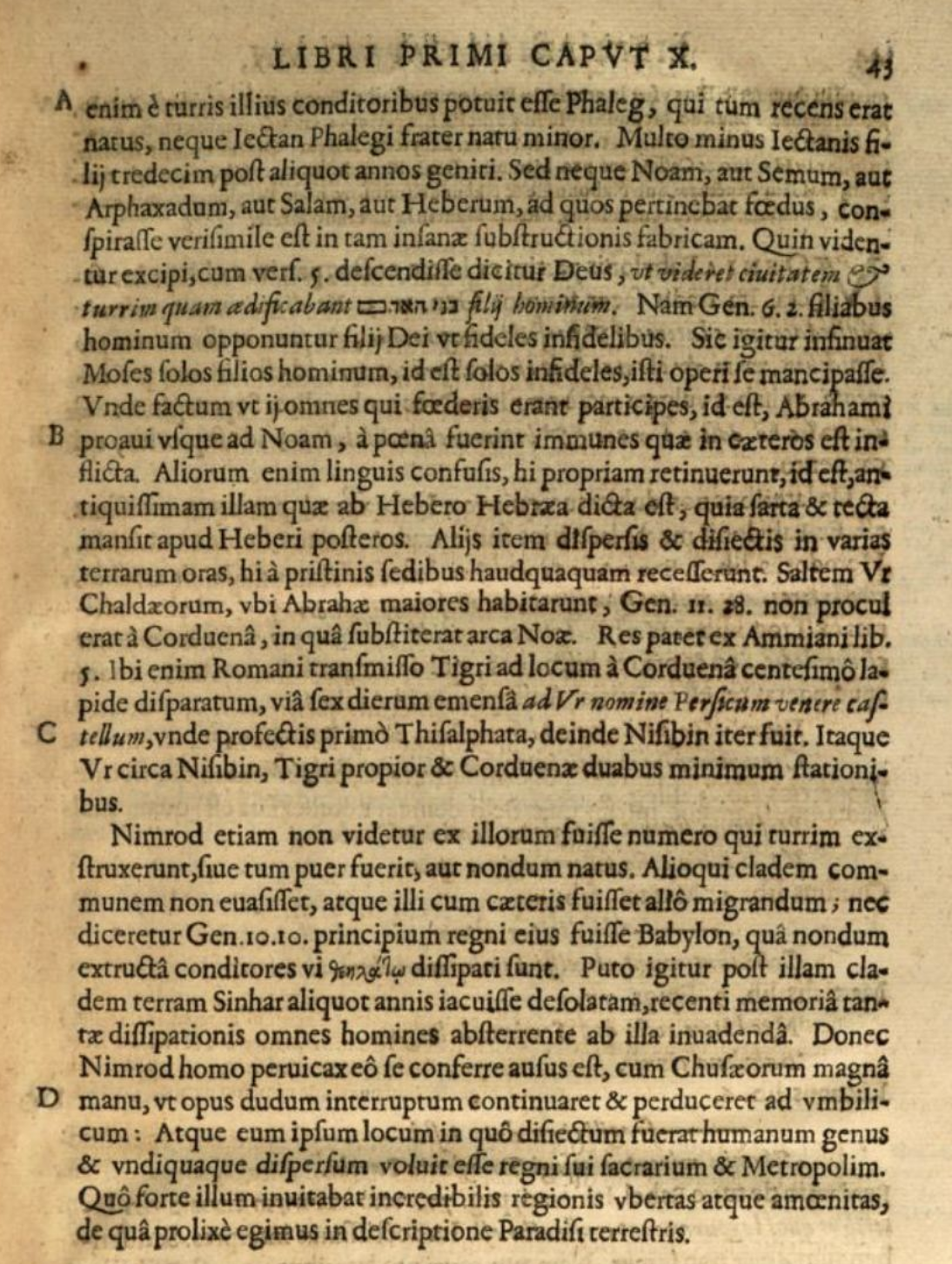
The geographical claim, in Latin.
Transcription & translation notes
New transcription from the facsimile and newly drafted translation. Line breaks and the printed Chaldæ-orum word division are joined; the printed Vr is retained. This is a selected sentence, not a diplomatic transcription of the page. The statement about the ark is part of Bochart’s argument.
The early modern printed text is public domain. The supplied facsimiles are reproduced here as source material; the capture’s exact scan edition has not been established.
The argument joins theology and geography.
- Who participated in Babel? Bochart distinguishes Abraham’s ancestors from the builders and the punishment of dispersion.
- What would that imply? He reasons that those exempt retained their language and ancestral settlement while others dispersed.
- Where does he place Ur? The page brings Ur of the Chaldeans near Corduene and appeals to Ammianus’s Roman itinerary, with a Persian fortress called Ur and travel toward Nisibis.
- Which connection needs proof? The move from a place named in a much later classical itinerary to the Ur of Genesis requires its own geographical and chronological case.
This is already more explanatory than treating “a northern Ur” as one undifferentiated opinion. We can identify Bochart’s premises, the evidence he adduces and the point at which an identification is made. Testing those steps is the next source task.
Questions the page cannot settle alone.
No Muslim source is cited or rejected in the shown extract. That local observation cannot establish Bochart’s treatment of Muslim testimony elsewhere, still less his motive. Claims about exclusion require a wider reading and exact examples.
The next work is concrete: establish the edition from its title page; transcribe the surrounding Latin; check the Ammianus passage in its original language and itinerary; and compare Bochart’s other relevant chapters. Then read Bryant and Bush in their own editions to discover how they receive or challenge the argument.
The notebook supplies a source and an inspectable argument. It leaves the proposed modern location open. That is one small step in the larger history of how biblical geography became authoritative.
First research edition, 20 October 2026. Selected passages have been checked in the named editions; translations are newly drafted working translations unless attributed otherwise. Critical collation and independent translation review remain open. How to read the source notes.